
ARTICLE
Helical Piles vs. Concrete Piers: Technical Analysis for Pipeline Support
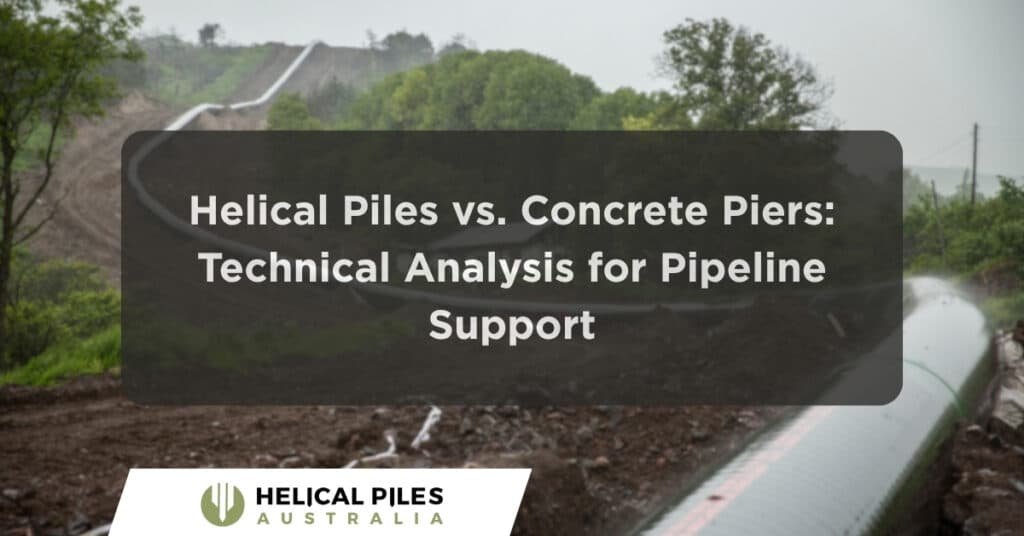
This article provides a technical comparison of helical piles and concrete piers for pipeline support systems in Australia. It examines installation processes, geotechnical performance in various Australian soil conditions, load-bearing capacities, and lifecycle costs.
For engineers, the choice between these deep foundation systems depends on project-specific factors including site accessibility, environmental sensitivity, soil reports, and adherence to Australian Standards. This analysis presents the data needed to select the appropriate foundation, ensuring long-term pipeline integrity and stability.
Summary
- Function: Both helical piles and concrete piers provide foundational support for pipelines, but their mechanisms, installation processes, and ideal applications differ significantly.
- Helical Piles: Offer rapid, low-disturbance installation, immediate load-bearing capacity, and excellent performance in tension and compression, making them ideal for remote or environmentally sensitive projects.
- Concrete Piers: A traditional, well-understood method providing high compressive strength, but requiring excavation, curing time, and significant site access.
- Key Australian Considerations: The choice is heavily influenced by Australia’s diverse and often challenging soil conditions, such as reactive clays and sandy soils, as well as adherence to AS 2885 and AS 2159.
- Decision Matrix: Selection depends on a project-specific analysis of soil reports, accessibility, project timelines, environmental constraints, and loading requirements (including pipeline buoyancy control and vibration).
Pipelines in Australia traverse vast and varied landscapes, subjecting them to thermal expansion, soil movement, seismic activity, and hydrodynamic forces. A stable foundation is paramount to maintain the pipeline’s structural integrity, prevent stress fractures, and ensure operational safety.
The primary role of the support foundation is to transfer the pipeline’s dead weight, product load, and any dynamic forces safely to a competent soil stratum. The pipeline foundation design must account for both vertical loads (compression) and uplift forces (tension) caused by factors like buoyancy in high water tables or expansive soil heave.
Overview of Helical Piles (Screw Piles)
Helical piles, often referred to as screw piles, are a type of deep foundation system. They consist of a central steel shaft with one or more helical plates (helices) welded to it. The pile is screwed into the ground using a hydraulic torque motor attached to an excavator or other machinery. As the pile advances, the helices displace the soil with minimal disturbance. The pile’s load-bearing capacity is derived from the end-bearing of the helices on competent soil and the friction along the shaft. This capacity can be verified in real-time by correlating the installation torque to an engineered value, providing immediate quality assurance.
Overview of Cast-in-Place Concrete Piers
Cast-in-place concrete piers are a more traditional foundation method. The process involves drilling a cylindrical hole into the ground, often using an auger, until a suitable bearing stratum is reached. A steel reinforcement cage is then placed into the hole, and wet concrete is poured in. The pier must then cure for a period, typically ranging from 7 to 28 days, to achieve its specified design strength. The load capacity of a concrete pier is primarily derived from end-bearing on the soil or rock at its base and skin friction between the concrete and the surrounding soil.
Comparative Analysis of Installation and Logistics
| Factor | Helical Piles | Cast-in-Place Concrete Piers |
|---|---|---|
| Typical Installation Time (per unit) | 20 - 40 minutes | 4 - 8 hours (excluding curing) |
| Curing / Wait Time | None (immediate loading) | 7 - 28 days |
| Soil Spoil Generation | Minimal to none | High volume |
| Weather Dependency | Low (can install in most conditions) | High (rain, freezing temps affect pour) |
| Quality Assurance Method | Real-time torque correlation | Concrete slump tests, cylinder break tests |
Equipment Requirements and Site Access
Helical pile installation requires less heavy machinery, often just an excavator with a torque drive head. This smaller equipment footprint makes them ideal for remote pipeline construction and sites with limited access, reducing overall site disturbance. In contrast, concrete piers require extensive equipment, including large auger rigs, concrete trucks, and cranes. This demands established access roads and significant laydown space, posing logistical and financial challenges in remote Australian settings.
Spoil Removal and Environmental Site Impact
Helical piles cause minimal site disturbance, as they are screwed into the ground and generate almost no soil spoil. This makes them an excellent solution for environmentally sensitive areas, eliminating spoil disposal costs and impact. The augering for concrete piers produces a large volume of spoil that requires costly management and transport. The resulting open excavations can also pose safety risks and are vulnerable to water ingress.
Economic and Project Lifecycle Cost Analysis
Initial Material and Installation Costs
While material costs for a single helical pile may be higher, the total installed cost is often lower than for a concrete pier. This is because the rapid installation speed of helical piles significantly reduces labour, equipment hire, and site time. The helical piles vs concrete piers cost comparison becomes favourable when also factoring in the elimination of spoil disposal expenses.
Long-Term Maintenance, Durability, and Corrosion
Hot-dip galvanised helical piles offer a design life of 50-100+ years in many soil conditions, meeting Australian standards for corrosion protection. Properly installed concrete piers are also highly durable but can be susceptible to cracking or sulfate attack in certain soils, potentially exposing steel reinforcement to corrosion.
On Helical Piles vs. Concrete Piers for Pipeline Support
The selection between helical piles and concrete piers is an engineering decision based on project variables. Helical piles offer clear advantages in speed, accessibility, and performance in challenging Australian soils, often resulting in lower overall project costs. Concrete piers remain a viable solution, especially for projects with extreme compressive loads and simple logistics. A careful analysis of geotechnical data, schedules, and budget will determine the optimal foundation to ensure long-term pipeline stability.
Frequently Asked Questions About Helical Piles vs. Concrete Piers for Pipeline Support
Are Helical Piles Better Than Concrete?
Neither is universally better; they suit different applications. Helical piles are preferred for tight schedules, poor soil conditions, limited access, or environmental sensitivities. Concrete is excellent for high compressive loads where site access and excavation are straightforward.
What Are the Disadvantages of Helical Piles?
Disadvantages include a higher upfront material cost and unsuitability for ground with dense rock or boulders that can prevent installation to the required depth. Their capacity is also entirely dependent on the strength of the surrounding soil.
How Long Will Helical Piles Last?
A hot-dip galvanised helical pile, manufactured to Australian standards, can have a design life of over 100 years. In more corrosive soils, additional protection may be needed.
Are Helical Piles Cheaper Than Concrete Footings?
The total installed cost is often cheaper. Savings are realised through faster installation, reduced labour and equipment needs, and no spoil disposal costs, which often outweighs the higher material price.
What Is the Main Advantage of Helical Piles Over Other Piling Systems?
The main advantage is rapid installation with immediate load-carrying capability, eliminating concrete cure time. Other key benefits include minimal site disturbance, verifiable capacity via installation torque, and strong performance in both tension and compression.
How Much Weight Can a Helical Pile Support?
Capacity depends on the pile design and soil conditions, ranging from a few tonnes to over 100 tonnes (1000 kN) for large-diameter piles used in infrastructure projects. A site-specific geotechnical analysis is required to determine the exact capacity.
Need a quote or more info? Start here.
Contact Us
info@helicalpilesaustralia.com.au
+61 2 7251 9258
Mon–Fri, 8:00am–5:00pm AEST

Built for complexity.
Engineered for certainty.
A trusted partner for large-scale energy and infrastructure projects where precision isn’t optional, it’s mandatory

Engineered foundation systems for energy and infrastructure across Australia.
© 2026 Helical Piles Australia. All rights reserved.
Privacy Policy
Contact Us
info@helicalpilesaustralia.com.au
+61 2 7251 9258
Mon – Fri, 8:00am – 5:00pm AEST
Location
223 Liverpool Street
Darlinghurst, NSW 2010