Screw Pile Footings: Install Foundations Up to 50% Faster in Australian Soils
Traditional concrete footings often slow down construction, introduce curing delays, and become unpredictable in challenging Australian ground conditions such as reactive clays, coastal sands, and expansive soils. You need a foundation system that installs rapidly, delivers immediate load capacity, and reduces risk across solar, transmission, and pipeline projects.
Screw pile footings – also known as helical piles – provide up to 50% faster installation with verified performance in Australian soils, while supporting compliance with AS 2159 and the National Construction Code. They are especially effective for solar farms, transmission towers, pipelines, and other infrastructure where access, programme, and ground risk are critical.
This guide explains how screw pile footings work, where they outperform concrete footings, and how to use them with confidence on your next project.
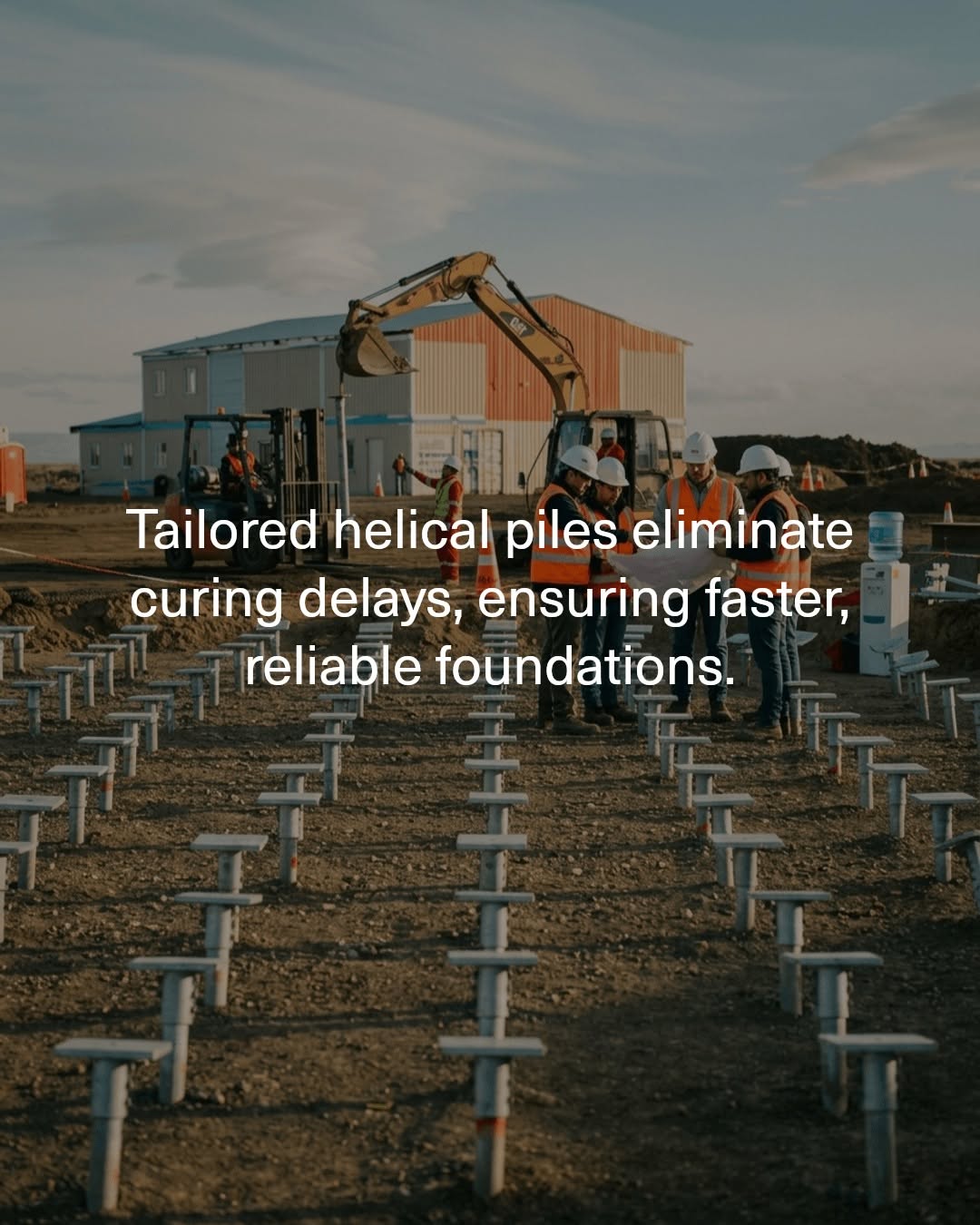
Table of Contents
What Are Screw Pile Footings?
Screw pile footings are steel deep foundation elements with one or more helical plates welded along the shaft. When rotated into the ground, the helices advance with minimal soil disturbance and develop capacity through a combination of shaft friction and bearing at each helix.
Because they are installed using torque-controlled equipment, screw piles provide predictable load–torque relationships and can be verified during installation using engineering design methods accepted in Australian practice. This makes them particularly attractive for civil and infrastructure projects that need both speed and traceable engineering.
Key Benefits for Australian Projects
Speed and Installation Efficiency
Screw pile footings significantly reduce installation time compared with conventional concrete footings. There is no need for bulk excavation, formwork, reinforcement placement or concrete curing. Once piles are drilled or driven to design depth and torque, they can be loaded immediately.
For projects on tight programmes, this often translates into:
Up to 50% faster foundation installation on suitable sites
Reduced labour and equipment requirements
Less sensitivity to weather-related delays, especially rainfall affecting excavation and concrete placement
Engineering Tip – Programme Certainty
By removing curing windows and concrete quality variables, screw piles offer more reliable, repeatable installation durations, which is critical for EPC contractors working to milestone dates.
Immediate Load Capacity
Unlike concrete footings, which require a curing period before full capacity is achieved, screw piles are designed to carry load as soon as installation is complete. This immediate load capacity allows:
Structural steel or racking to be erected promptly
Temporary and permanent loads to be applied without delay
More efficient sequencing between piling, structural trades and electrical teams
For solar farms, this means racking can be installed as soon as the pile is verified. For transmission towers and pipelines, it allows critical assets to be stabilised quickly, improving safety and programme.
Reduced Ground Disturbance
Screw piles are installed with relatively small equipment and minimal excavation. Soil is displaced rather than removed, and spoil volumes are typically far lower than with bored piers or spread footings. This creates several benefits:
Lower environmental impact and reduced site remediation
Cleaner, safer work areas with less spoil management
Reduced risk of undermining nearby structures or services
On environmentally sensitive projects or constrained sites, this reduced disturbance is often a critical design factor.
Performance in Australian Soil Conditions
Reactive Clay
Reactive clays in many Australian regions undergo volume changes with moisture variation, which can damage traditional shallow footings. Screw piles penetrate below the zone of greatest reactivity, transferring loads to more stable strata.
When designed and detailed correctly, screw pile systems can:
Bypass the upper reactive zone
Reduce differential movement under slab edges and perimeter foundations
Provide a more stable platform for lightweight and modular structures in clay-dominated areas
Coastal Sand
Coastal sand typically has lower cohesion and can be difficult for conventional footing systems, especially where scour and erosion are present. Screw piles can be configured with helix spacing and diameters suited to granular soils, providing reliable capacity without over-excavation.
In coastal environments, stainless or protected steel specifications and appropriate corrosion design life considerations are essential. Screw piles can be designed to these requirements with appropriate coatings and sacrificial steel to achieve design life expectations.
Expansive and Variable Soils
Many infrastructure corridors cross multiple soil types over relatively short distances. Screw piles can be adapted with variable helix configurations, diameters and embedment depths to handle:
Expansive clays
Fill and heterogeneous ground
Transitional profiles between rock and soil
This adaptability reduces the need to change footing type across a project and simplifies construction while maintaining engineering assurance.
Compliance with AS 2159 and Australian Standards
Screw pile foundations in Australia should be designed and installed in accordance with AS 2159 – Piling – Design and installation, as well as relevant provisions in the National Construction Code and project-specific specifications.
This includes consideration of:
Geotechnical investigation and soil parameters
Ultimate and serviceability limit state design
Shaft and helix corrosion allowances
Installation torque criteria and verification
Load testing or proof testing regimes where required
By working with experienced piling engineers and contractors, project teams can demonstrate compliance with AS 2159 and satisfy principals, councils and asset owners that screw pile footings meet the necessary safety and performance standards.
Applications in Modern Infrastructure
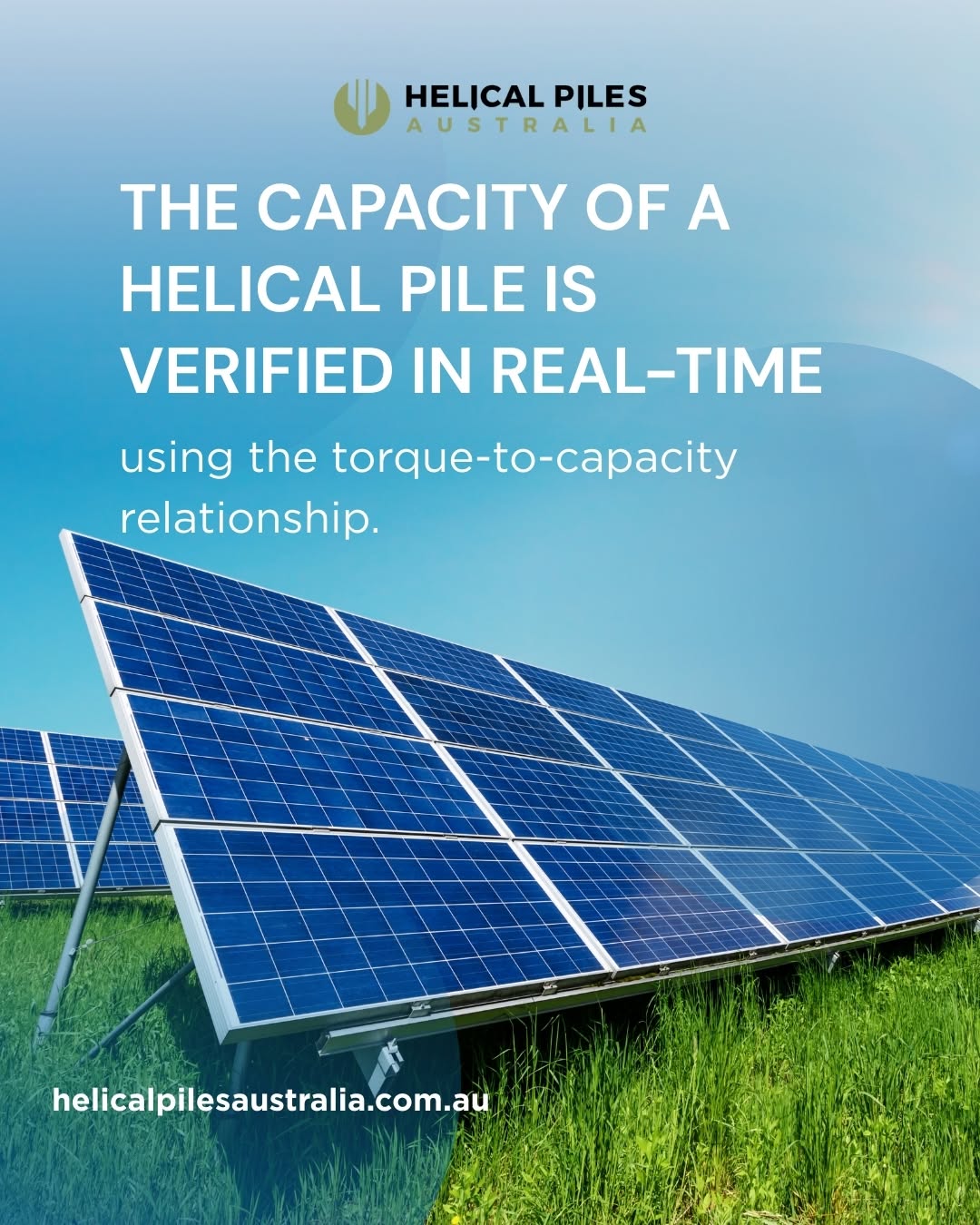
Solar Farm Foundation Solutions
Solar farms demand rapid installation, minimal disturbance and predictable capacity across large arrays. Screw piles provide:
Fast foundation installation with immediate load capacity
Reduced spoil and site clean-up
Flexibility to adjust pile lengths on site as actual ground conditions vary
This allows EPC contractors to keep construction teams moving and align mechanical, electrical and civil works more efficiently, improving overall project economics.
Transmission Tower Footings and Pipeline Supports
Transmission assets and pipelines require stable foundations that can resist uplift, overturning and lateral loads in varied soils and exposure conditions. Screw pile footings can be configured as:
Compression piles for vertical loads
Tension piles for uplift resistance
Group arrangements to resist combined loading and moments
Their ability to anchor into more competent strata and provide robust resistance makes them well suited to regions with wind, flood and cyclone exposure.
Industrial, Mining and Civil Infrastructure
Beyond energy infrastructure, screw piles are increasingly used for:
Industrial equipment foundations
Rail and civil structures
Temporary works and construction platforms
Modular buildings and facilities in mining regions
Where access, ground conditions or schedule constraints make concrete footings inefficient, screw piles offer a practical alternative.
Engineering and Geotechnical Design Considerations
To achieve the benefits outlined above, screw pile footings must be treated as an engineered system rather than a generic product. Key considerations include:
Geotechnical inputs: Soil strength, stiffness, and stratigraphy from investigation and/or corridor data.
Pile configuration: Shaft diameter, helix size and spacing, and total embedment depth to meet design loads.
Installation criteria: Target torque values, RPM, and installation records to verify capacity.
Durability design: Corrosion allowances, coatings and design life consistent with asset requirements.
Connection details: Brackets, heads, and interfaces with structures or frames designed to transfer loads cleanly.
Quality control: Inspection and documentation of installation, including any load or proof testing where specified.
When these elements are integrated into a project’s design documentation and construction methodology, screw piles provide a high confidence, low-variability foundation solution.
Screw Piles vs Concrete Footings
Screw Piles vs Concrete Footings – Key Differences
Feature | Screw Pile Footings | Concrete Footings |
|---|---|---|
Installation Speed | Fast installation, no curing | Slower; excavation, formwork, curing |
Curing Time | None – immediate capacity | 3–28 days depending on design |
Load Capacity | Verified via torque and testing | Dependent on concrete quality and soil |
Ground Disturbance | Low; minimal excavation | Higher; significant excavation and spoil |
Environmental Impact | Less spoil and reduced remediation | More waste and site rehabilitation |
Weather Sensitivity | Less affected by rainfall | Rain can delay excavation and pours |
Access Requirements | Smaller plant, good for tight sites | Larger plant, harder on constrained sites |
Suitability in Poor Soils | Adaptable configuration and depth | May require larger footings or piling |
Frequently Asked Questions
1. How much faster are screw pile footings than concrete footings?
Screw pile footings can often be installed up to 50% faster than conventional concrete footings on suitable sites. There is no curing period, and installation requires less excavation and formwork. Once a pile reaches its design depth and torque criteria, it can be loaded immediately. This compresses the critical path and reduces the risk of programme slippage due to weather or sequencing issues.
2. Are screw piles suitable for reactive clay soils?
Yes. In reactive clay soils, screw piles are typically designed to penetrate below the zone of greatest movement and anchor in more stable material. By doing so, they reduce the impact of swelling and shrinkage on the structure. Correct detailing of pile length, helix configuration, and corrosion allowances is essential, and should be informed by geotechnical data and AS 2159 guidance.
3. How do screw piles perform in coastal sand and expansive soils?
In coastal sand, screw piles can be configured to achieve capacity through appropriate helix design and embedment depth, avoiding large excavations. In expansive soils, they provide a deep foundation solution that reduces surface movement effects. In both cases, the piles must be designed with soil parameters, load cases and durability requirements in mind to achieve reliable performance over the asset’s life.
4. Are screw piles environmentally friendly compared with concrete footings?
Screw piles typically generate far less spoil than concrete footings, require smaller working areas and can be removed or modified more easily if future changes are needed. This results in lower ground disturbance, reduced waste and, in many cases, less remediation. From a project perspective, this can support environmental objectives and simplify site management.
5. Do screw piles meet Australian standards such as AS 2159?
When designed and installed correctly, screw pile foundations can comply with AS 2159 – Piling – Design and installation – and relevant National Construction Code provisions. Compliance involves appropriate geotechnical inputs, design checks for ultimate and serviceability limit states, durability design, and installation verification through torque and/or load testing.
6. Can screw pile footings be used for solar farms and transmission lines?
Yes. Screw piles are widely used for solar farm racking, transmission towers and other energy infrastructure because they combine rapid installation, immediate load capacity and verifiable performance in varied soils. Their ability to adapt to local ground conditions makes them well suited to long corridors and large arrays where soil changes frequently.
7. How are screw piles installed and verified on site?
Screw piles are installed using hydraulically driven equipment that rotates the pile into the ground. Installation records typically include torque, depth and any notable ground changes. Designers use torque–capacity correlations and, where required, load testing to confirm performance. These records become part of the project’s foundation documentation and quality assurance.
8. What information do engineers and project managers need to design screw pile foundations?
Key inputs include project load cases, geotechnical data, required design life, exposure conditions, access constraints and any specific requirements from the principal or asset owner. With these inputs, foundation specialists can determine pile sizes, configurations and installation criteria to meet project objectives and standard requirements.
Next Steps
Screw pile footings give engineers, EPC contractors and asset owners a practical way to reduce foundation risk, tighten programmes and improve performance in challenging Australian soils. When designed and installed correctly, they deliver immediate capacity, lower disturbance and robust compliance with AS 2159 and the National Construction Code.
If you’re considering screw piles for solar, transmission, pipeline or civil infrastructure projects, it’s critical to engage with specialists who understand both the engineering and the Australian ground conditions.
Contact Us
Discuss your project requirements, soil conditions and schedule constraints with a helical pile specialist. A short design conversation can confirm whether screw pile footings are the right fit and outline the steps for geotechnical assessment, design and installation planning.