Traditional foundation repair methods often stall projects with lengthy excavation and curing times. You need a solution that tackles structural settlement quickly, with less disruption and clear engineering certainty. Helical piers offer immediate load transfer and precision installation, cutting foundation repair time by up to 50% while handling Australia’s toughest soils with confidence. Learn more about the concept of helical structures.
Understanding Helical Piers
Helical piers, also known as screw piles, have revolutionized foundation repair by offering quick and precise solutions. They are designed to provide reliable support in challenging ground conditions.
Helical Piers and Their Purpose
Helical piers are steel shafts equipped with helical plates. Their main role is to transfer structural loads to stable soil layers, ensuring a robust foundation for buildings. These piers are especially useful in areas with reactive clay soils or where traditional methods struggle. Unlike other solutions, helical piers are installed using hydraulic motors, which allows them to reach deeper soil layers without the need for massive excavation.
Installation Speed and Efficiency
One of the standout features of helical piers is their installation speed. By eliminating curing times associated with concrete, projects can move forward much faster. With the ability to handle immediate loads, helical piers cut down repair times significantly, making them ideal for projects with tight deadlines. The method requires less equipment and workforce, which further speeds up the process, allowing for quicker project turnover.
Predictability and Minimal Disruption
Helical piers minimize disruption to the surrounding environment. Their installation is vibration-free, reducing the impact on nearby structures and landscapes. This method ensures that projects proceed smoothly without the extensive site disturbances that traditional methods often cause. The predictable nature of helical piers provides peace of mind, knowing that the foundation is stable and reliable from the start.
Benefits of Helical Piers
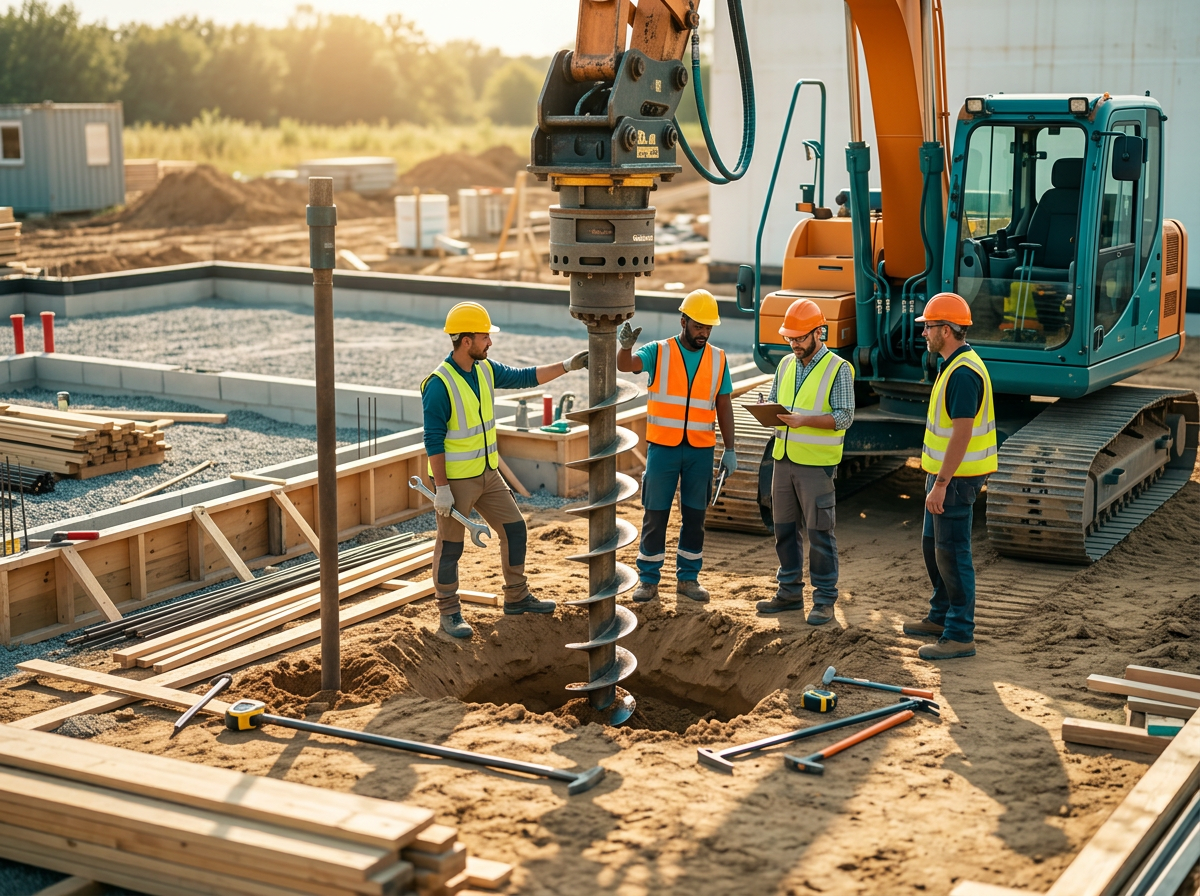
Helical piers offer numerous benefits that make them a preferred choice for foundation repair. They provide stability, low-impact solutions, and real-time verification.
Stabilizing Settled Structures
Helical piers excel at stabilizing structures that have settled over time. By anchoring into deeper soil layers, they prevent further movement and provide a solid foundation. This is crucial in areas with expansive clays or uncontrolled fill, where differential settlement can pose serious risks. The ability of helical piers to adapt to various soil conditions makes them a versatile solution for many projects.
Low-Impact Remediation Options
For projects in sensitive environments, helical piers offer a low-impact alternative. Their installation involves minimal excavation, significantly reducing ground disturbance and preserving the surrounding ecosystem. This makes them an excellent choice for projects where environmental concerns are a priority. The reduced site disturbance also means fewer logistical challenges and a cleaner worksite.
Real-Time Verification and Load Transfer
A key advantage of helical piers is the ability to verify their capacity in real-time during installation. This is achieved through torque correlation, which ensures that each pile meets the necessary load requirements. The real-time verification process allows engineers to confirm the foundation’s integrity on-site, providing assurance that the structure will remain stable under load. This method of immediate load transfer is crucial for projects that cannot afford delays.
Applications and Services
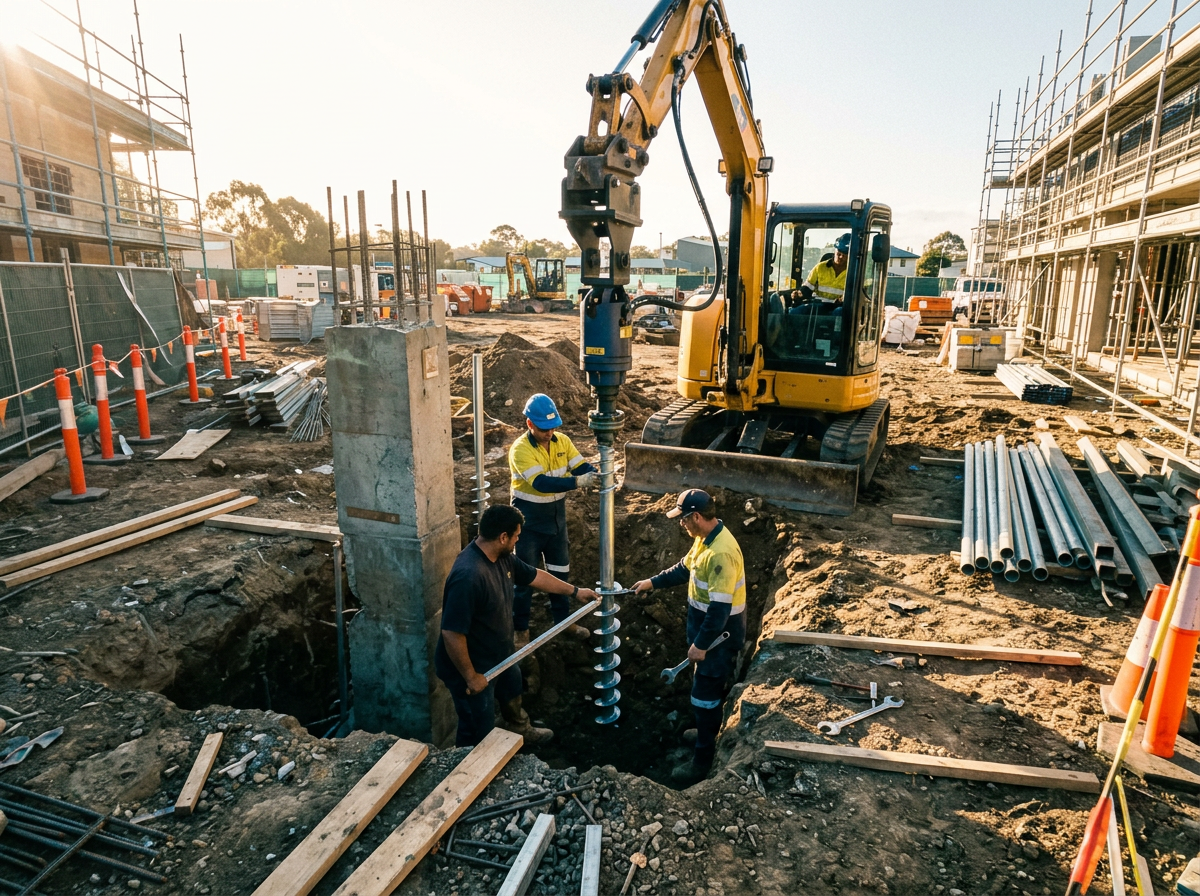
Helical piers are versatile and can be applied across various sectors, offering tailored solutions for commercial and industrial needs.
Commercial and Industrial Solutions
In commercial and industrial settings, helical piers provide reliable support for a range of structures. From underpinning commercial buildings to stabilizing industrial slabs, they offer a fast and effective solution. Their ability to handle immediate loads makes them a valuable asset in projects where time is of the essence. By reducing project timelines and minimizing disruption, helical piers help keep commercial projects on track and within budget.
Geotechnical Design Verification
Helical piers are supported by thorough geotechnical design verification. This process ensures that the piers are tailored to the specific soil conditions of each site, maximizing their effectiveness. By incorporating detailed soil analysis and testing, engineers can design helical systems that meet the unique demands of each project. This tailored approach helps mitigate risk and ensures long-term foundation stability.
Corrosion Protection and Custom Pile Design
Corrosion protection is a critical consideration in helical pile design. Standard methods include hot-dip galvanizing, which provides a protective zinc coating to extend the lifespan of the piles. For more aggressive soil conditions, additional measures like epoxy coatings may be employed. Custom pile designs allow for flexibility in addressing site-specific challenges, ensuring that the foundation solution not only meets but exceeds project requirements.
Frequently Asked Questions
What are helical piers used for?
Helical piers are used to stabilize and support structures by transferring loads to deeper, more stable soil layers. They are ideal for foundation repair, underpinning, and new constructions in challenging soil conditions.
How long does it take to install helical piers?
Installation of helical piers is significantly faster than traditional methods, as it doesn’t require excavation or curing time. Typically, a project can be completed in half the time it takes for conventional concrete foundations.
Can helical piers be used in all types of soil?
Helical piers are versatile and can be used in a variety of soils, including clays, sands, and silts. However, they may not be suitable for solid rock or areas with high concentrations of large boulders, where advancement is challenging.
How does the torque-to-capacity verification work?
Torque-to-capacity verification measures the installation torque of each helical pile to ensure it meets the required load capacity. This real-time verification provides assurance that the foundation is stable and secure.
Do helical piers require maintenance?
Helical piers are designed for durability and typically require minimal maintenance. With proper corrosion protection like hot-dip galvanizing, they offer long-lasting performance even in aggressive soil conditions.
Last chance for 2026 pricing – secure your foundation solutions today.